Ozymandias
Where the Nile and the River Tigris touched was a garden hindered only in beauty by its fateful decay. A man—a traveler—stood outside the walls. At the entrance was an obscure tunnel, with grape vines and jasmine branches in the dappled roof, and at the entrance, a dark bird—a raven—called to the man. There was something in its character and its sparse, pecked out feathers that suggested pain, and the man cringed. In the dreams of all men, birds figure as erotic.
The bird told him that inside, the ground was mossy, the leaves never fell, the fruits were greater than he’d ever seen, and the animals were fat and lazy.
The man asked if this was true, and eagerly stepped forward. He had not known what he had traveled for, but this was it.
The bird interrupted him with a twist in its neck. This is a special, and accursed place, it said. One man can see inside, and when he leaves, it will disappear forever. The ground will turn to dust, the trees will doff their leaves as easy as a summer dress, and the fruits will wither on them, and the river will deprive itself between those dead limbs, and the wild pigs will unwrap into their bones. One man can step inside, and peruse to his content, and feast with no end to his supply, but the moment he leaves—and you will leave—nothing.
The man paused only a moment to consider. Thought he, If it was made for one man to see, why should I not be the one to see it? Thought he, Some other man will come some day, and surely he won’t give it up. Thought he, I am sensitive. I am a gentleman, a poet. I would appreciate it while it lasted. Thought he, This beauty was allowed on condition that it would be fleeting. Thought he, It was made to be destroyed. And so he walked inside, as any man would, because in truth nothing satisfies a man quite like breaking something beautiful.
He walked amongst the trees, and at first encountered a boar with its tusk penetrating a chicken. They laid together on the moss, and the pig ate. They heaved like a great baroque painting till the end. So surprised and delighted was the man that he resolved to stay and watch. He’d expected himself to be the only kind of violence inside these walls, but the chicken belonged to a stomach now, and the garden belonged to him. He killed the pig.
That evening, the man picked fruits bigger than he had ever seen, and feasted on his tender prey. Then he dedicated himself to work. He converted the garden into an orchard and redirected water through with his rough hands, and he corralled the animals into pens. He fed them plentifully and they grew docile and fat like the bird had said. He slaughtered only those he needed, and in secret. They did not know what death looked like until the blood fled from their throat.
Come dusk, tired from his work, the man wrote poems: long epics celebrating the garden. He drew it, and created paint with crushed up bugs and tree bark and dried berries. He explored every inch of the landscape with an exacting, scientific style, and he knew that one day he would show it to the eyes back home. With each piece, his fascination with the burgeoning life before him was drawn out onto the page. With every iteration, the body of his work grew more comprehensive, but he grew blind to the life in front of him. The pages did his seeing for him, and he had less to discover. He thought of the endearing and ugly city at home, the only thing that gave him real pleasure. He wondered—couldn’t help but wonder—how much more beautiful his home would be with his artwork ringing through the streets.
Eventually, the man grew restless in his routine, but he stayed, and wrote, and drew with fury. He hadn’t recorded everything yet, and he had to finish, so he could bring the garden with him. He knew his home would be depending on him. And he did finish, eventually, when grey began to speckle in his beard, and he thought he’d expel his entrails if he consumed one more peach. Only then did he go home. He did not look behind him when he left, for he knew that without him, the trees and the animals would die.
When he saw the cracked dirt, and rotten buildings, and fences, and excrement along the horse-beaten dirt roads, he nearly cried. He showed his art around, and it was appreciated by a few intimate friends, made its way into small collections. He was contented, for he’d finished what he’d set out to do. He ordered a maid to strip dust covers from the furniture and hang some of his work on the walls of his estate, but he failed to notice it. It merely imparted the impression of a fresh, off-white coating.
Occasionally, when he thought of the garden, he only felt sick.
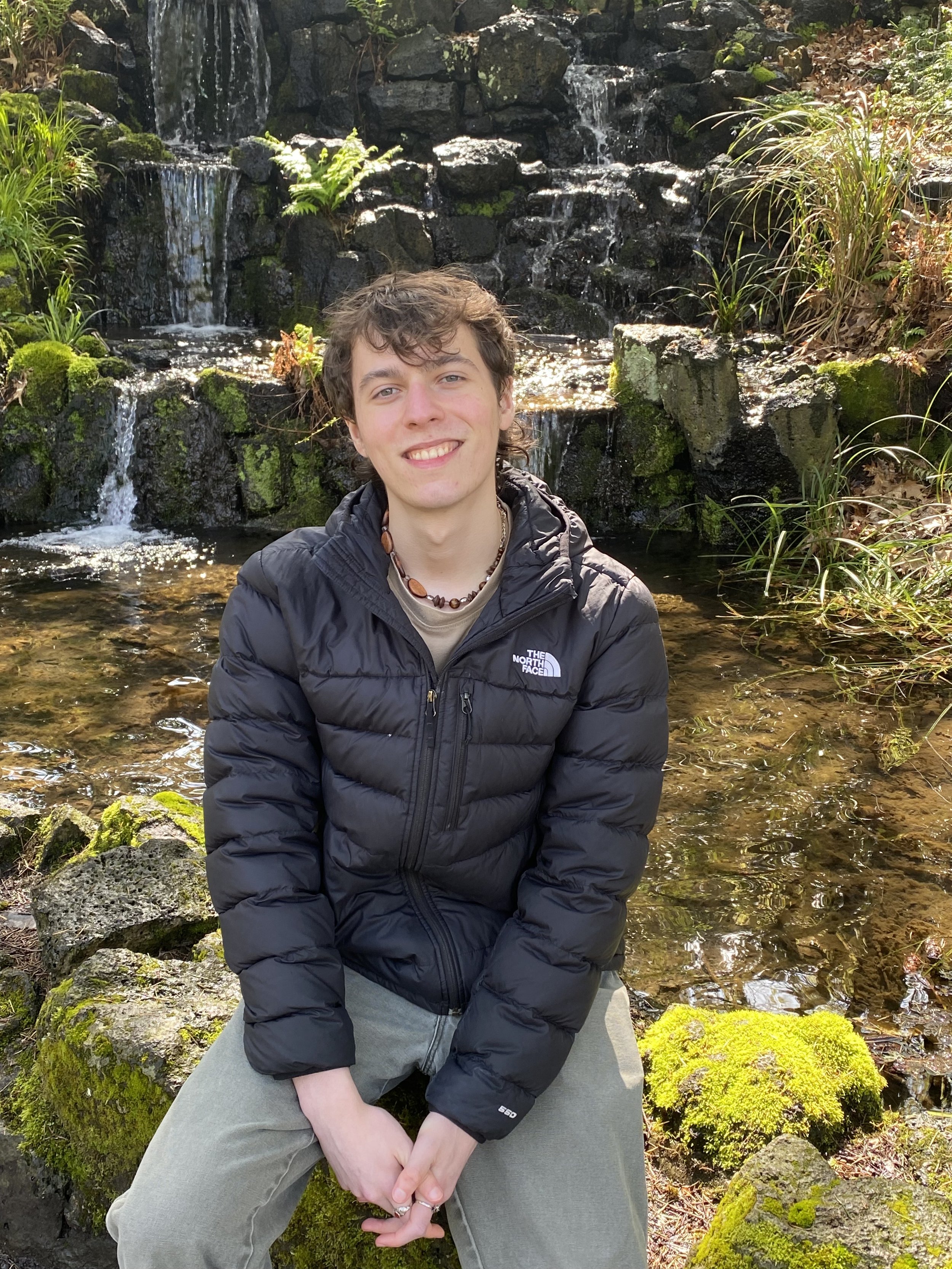
Austin Thornton
Austin Thornton is a diviner of refined sentimentalism, a modern
metaphysical, a possible human, a senior editor at the gothic magazine The Solitude Diaries, and the winner of several scholarships and awards, such as Oregon State University’s 2023 WIC Award and 2025 Provost Prize. Poetry, nonfiction, and fiction from this author is featured or forthcoming in /temz/, Flash Fiction Magazine, PRISM, and elsewhere, including a small TV show called Lyrical Lounge. A novel is in progress, but more short stories and poems will be procrastinated with.