Naucrate’s Wish
He was born beak first. His wings, wet and heavy, were pressed around the swell of his abdomen, his claws tucked as though he were already protecting her from what he would become. The nurse fainted. The doctor smiled with her lips, but held worry close in her eyes.
His mother wasn't surprised. While still pregnant she could feel his spine, a rosary inlaid with pearls, and his sharp mouth like a clasp rasping prayers against the ribbed cave of her bones. She pressed his beak to her breast, and gentled his wings in her arms. She held him as the cord was cut and he opened his new blue eyes, wide and wild in this world. “I love you,” she said, “I'm so glad you're here.”
He could fly before he could walk, and he would flutter from his crib to her bed and wrap himself in the nest of her hair. She kept his talons, five on each hand and foot, trimmed short, and preened the feathers on his wings. She pressed kisses onto the fleshy parts of his body, his dimpled knees and round cheeks, the slopes of his shoulders and belly. She wiped his beak. His first word was “love.”
The city once felt like the world. Now the buildings were closer than a wingspan, and the scratch of sky above was too high to reach. The mother could only catch glimpses of the moon, and missed her changing gaze. He had never seen a star. Only kings granted access to the sky. She wanted to raise him where space and bodies weren’t tradable commodities. They took the train, and the tracks stitched through the moving window red as thread in the morning light. As he slept swaddled against her chest, his beak swept under his wing, the flint of his feathers could have been the soft edges of any child's toy clutched in sleep.
In the country they rented a yellow cottage covered in ivy from a silver-haired woman who smelled like the wind and smiled like stars and tucked tarot cards in her apron pocket. Sometimes she appeared opulent as a polished opal, others thin as a pale stalk of wheat. She drove to town every week in her brother’s farm truck, bringing home a bag of groceries for her tenants.
Mother and son planted a garden, crooked vines of peas and beans, tomatoes like small trees, and a checkerboard of lemon thyme. Wild strawberries blanketed the meadow, and blackberries tumbled over the fence. The boy labored over the berries, picking them individually with the sharp curve of his beak. He’d fill a basket and carry it across the green thatches to the crooked house, his feathers stained violet with living shadows of sunshine. The mother spooned the purple and red berries into earthenware bowls, sprinkled them with sugar, and poured cream over the top. They leaned against each other at the edge of the slumped porch, the ferine world teeming around them as they ate.
At night they traced the constellations with fingers and talons, they gazed at the moon and watched her daily transformation. They slept curled around each other in the mother’s bed. As they fell asleep she told her son the story of Icarus, except instead of flying away from his father Icarus was flying away from Minos with his mother, and together they soared past the sun towards the moon, shedding their flesh for feathers as they rose.
The silver-haired woman read the mother’s tarot cards one afternoon, spreading the deck like panes of stained glass over the strawberry blanket. The boy played along the edge of the trees, half in sunlight, balanced on his talons and fluttering between berry patches. The woman told the mother the universe was granting her a wish and held the mother’s hand to her heart. The young woman reached up to cup the glimmering sand of the older woman’s face and pressed her lips against the moon shell ear.
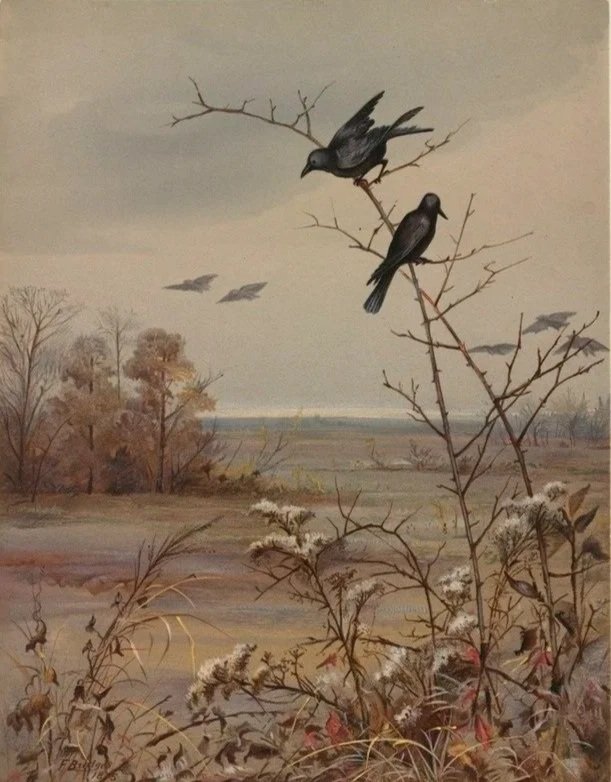
That night the mother caressed her son’s feathers, stroked his skin and touched the tip of her nose to his beak. In the morning, as the sun stretched his fingers between the gaps in the small wood-framed house, the silver-haired woman unlocked the door and threw the windows open. She watched as two birds leaped from the frame and soared over the arrow-tipped trees into the sky.
Becky Petterson
Becky Petterson holds a bachelor of science in communication with an emphasis in journalism from Southern Oregon University. Her work has appeared in Mslexia, Pile Press, Peach Fuzz, The Lemonwood Quarterly, Flash Fiction Magazine, carte blanche, and Redivider. She won Apple in the Dark’s 2025 flash fiction competition and was a runner-up for the 2025 Stella Kupferberg Memorial Short Story Prize. She lives in the Pacific Northwest with her family.